


Topics
-
2025.03.27
INFO
The website of the External Formulation Association has been renewed.
About external drugs

Patch
It is a drug product in which the active ingredient and other components are spread as a thin layer over a fabric or plastic film. When this drug product is applied to the skin, the active ingredient is absorbed and exerts its intended effect.
This type of product is called Transdermal and Topical Delivery Systems (TDS), Transdermal Patches or Cutaneous Patches.

Liniment
A drug that is effective when applied directly to the skin or mucous membranes. Generally, they are used to treat and alleviate diseases and injuries.
Patch Classification
"Patches" is a general term that is broadly divided into “topical" and "systemic" depending on the area where the active ingredient acts, and further divided into "analgesic" and "non-analgesic" depending on the purpose.
|
Analgesics |
Non-analgesics |
|
|---|---|---|
|
Topical |
Topical transdermal analgesics |
Topical transdermal drugs |
|
Systemic |
Systemic transdermal analgesics |
Systemic transdermal drugs |
|
Topical |
The patch is applied to the affected area, where the active ingredients penetrate directly to exert their therapeutic effect. |
|---|---|
|
Systemic |
The active ingredients exert their therapeutic effects by reaching the entire body through the capillaries beneath the skin. |
Topical and systemic patches are effective for a variety of conditions
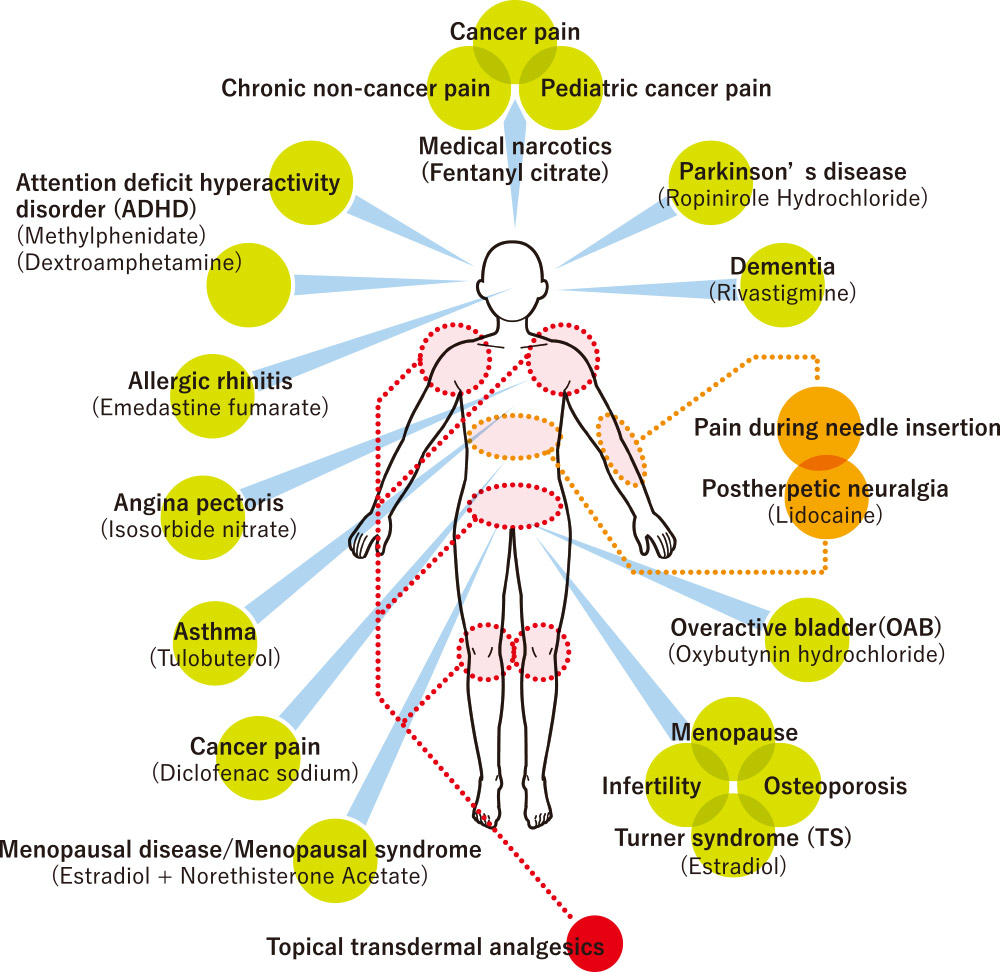
Features of patches used as topical transdermal analgesics
Local effects can be expected
Patches are applied directly to the affected area, so direct effect on the affected area can be expected.
Convenient administration
Unlike injections, no complicated procedures are needed. In addition, no water is required for administration, allowing for medication at any time.
Various sizes
Patches come in a variety of sizes, allowing for a wide selection depending on the size of the affected area and the application site.
Take even for those who cannot take oral intake
Easy to use even for people with swallowing difficulties (such as elderly people who may feel anxious about swallowing)
Not subject to the first-pass effect
The active ingredients in patches are absorbed through the skin, so they are not metabolized by the liver.
Administration can be easily discontinued
If side effects occur, administration can be discontinued immediately by simply peeling the patch off.
Fewer systemic side effects
Since localized treatment is possible, patches have less impact on the whole body and can reduce systemic side effects.
Easy to confirm administration
Patients and caregivers can visually check whether the patch is attached, which helps prevent forgetting to take the medication.
Topical transdermal analgesics are widely used in Japan
|
Pain relief and anti-inflammation for the following diseases and symptoms: |
|
|---|---|
|
Tendinitis, Peritendinitis |
|
|
Epicondylitis |
|
Topics
Recommendation Statement
Topical NSAIDs are effective in relieving pain and improving function in patients with knee osteoarthritis, without causing serious complications.
Strength of Evidence
Level B: Moderate confidence in the estimate of effect
Strength of Recommendation
Level 1: Strong(Recommended for implementation)
References
- Conaghan PG, et al. Ann Rheum Dis. 2013;71.
- Baraf HSB, et al. Drugs Aging. 2011;28(1):27-40.
- Knee W, et al. J Pain Res.. 2013;6:743-53.
- Yataba I, et al. J Pain Res.. 2017;10:867-80.
- Rother M, et al. J Rheumatol. 2013;40(10):1742-8.
- Simon LS, et al. Pain. 2009;143(3):238-45.
- Varadi G, et al. Pain Physician. 2013;16(6):E749-62.
Glossary
Lower back pain refers to a condition in which pain or discomfort occurs in the lower back. It can be caused by structural problems such as muscles, ligaments, discs, or bones, or by nerve compression. Lower back pain can range from temporary to chronic, and in most cases requires treatment with appropriate rest, exercise, stretching, and in some cases, a doctor's diagnosis and analgesics. Early treatment is important as it can interfere with daily life.
This is a disease in which the cartilage in joints wears away, changing the shape and function of the joints. This causes symptoms such as pain, stiffness, swelling, and difficulty moving in the joints. It is particularly common in the knees and hip joints. Causes include aging, excessive strain, injury, and obesity. Treatment includes analgesics, rehabilitation, and in some cases surgery.
It is also known as “frozen shoulder⇒Shoulder periarthritis." This condition occurs when the muscles, tendons, ligaments, and other tissues around the shoulder become inflamed, causing pain and difficulty moving. It is characterized by particularly severe pain at night and a catching sensation when moving the shoulder. The cause is often unclear, but it may be related to aging, long-term overuse of the shoulder, or injury. Treatment involves analgesics, rehabilitation, and in some cases, injections or surgery.
This refers to inflammation of tendons or tendon sheaths. Tendons are tissues that connect muscles to bones, and the tendon sheath is a bag-like structure that surrounds the tendon, making it easy to slide and facilitate movement. When tendons or tendon sheaths become inflamed due to overuse, repetitive movements, or injury, it can cause pain, swelling, and difficulty in movement occur. This condition is particularly common in the wrists, fingers, and shoulders. Treatment involves rest, icing, analgesics, and in some cases, injections and rehabilitation.
This is a condition involving muscles experience pain or discomfort after exercise or prolonged activity. It is caused by micro-tears and inflammation in the muscles. Pain typically occurs the day after or a few days after exercise. Muscle pain can be relieved by adequate rest, stretching, and heat application. Analgesics may also be used to temporarily relieve pain.
This is a condition in which an injured area becomes swollen and painful. This occurs when blood vessels are damaged, causing bleeding and inflammation, which causes blood and body fluids to pool around the area, resulting in swelling. Pain is also felt when nerves are stimulated. It is generally seen after trauma such as bruises, sprains, and cuts. Treatment involves using ice to reduce swelling and pain by cooling, rest, and analgesics as needed. Proper treatment will promote a speedy recovery.
Outline of the association
The purpose of this Association is to investigate a nd study the issues related to drug products for external use (patches and creams) and to improve the relationship among the members, as well as to contribute to the improvement of national medical care through the smooth supply of external drugs.
The Association conducts the following activities to achieve the intended objectives:
- Exchange of information among members and compilation of fair opinions
- Collection of internal and external information on the efficacy, safety, quality assurance, and research studies of external drugs
- Research on approval, registration, and reevaluation of external drugs
- Survey and research on the quality of raw materials of external drugs to ensure supply and demand
- Research on how to ensure the wide use and expansion of external drugs
- Conduct of academic seminars and symposia on external drugs
- Studies on the establishment of good order in external drugs distribution
- Promotion of fair promotional activities for external drugs
- Communication with relevant administrative organs and organizations, and submission of opinions
- Other matters necessary for the achievement of the Association's purpose

Organization chart

Overseas business by member companies
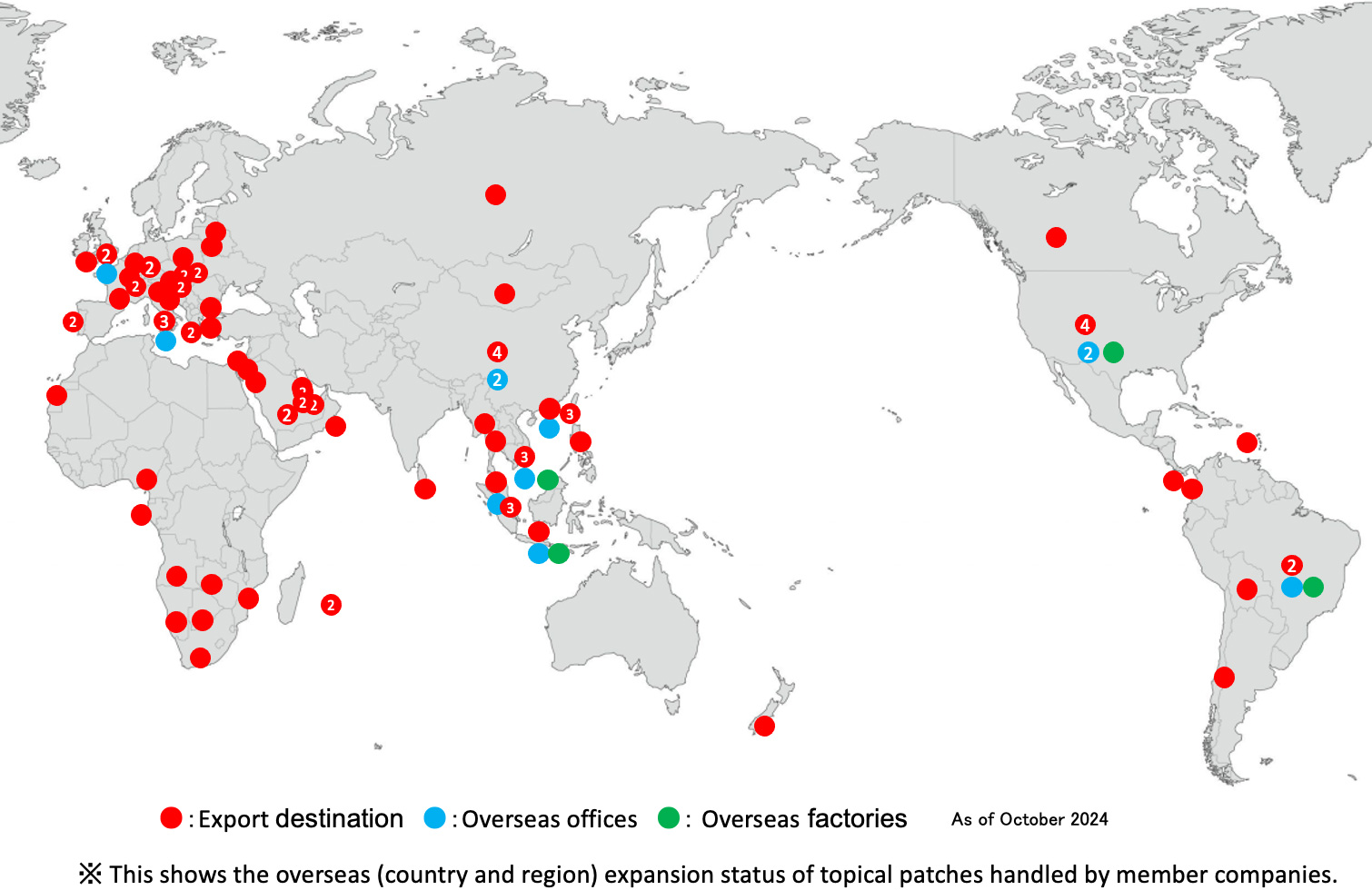
Member companies
(companies related to medical patches)
- Oishi Koseido Co., Ltd.
- OKAYAMA TAIHO Pharmaceutical Co., Ltd.
- Kyukyu pharmaceutical Co., Ltd.
- Kowa Company, Ltd.
- Daiichi Sankyo Co.,Ltd.
- Taikyo pharmaceutical co.,Ltd.
- Taiho Pharmaceutical Co.,Ltd.
- DIA Pharmaceutical Co.,Ltd.
- Teika Pharmaceutical Co.,Ltd.
- Teikoku Seiyaku Co., Ltd.
- Toko Pharmaceutical Industries Co., Ltd.
- Dojin Iyaku-Kako Co.,Ltd.
- TOKUHON Corporation
- NICHIBAN CO.,LTD.
- NIPRO PHARMA CORPORATION
- Hisamitsu Pharmaceutical Co.,Inc.
- MIKASA SEIYAKU CO.,LTD.
- YUTOKU PHARMACEUTICAL IND.CO.,LTD.
- LEAD CHEMICAL Co.,Ltd.
Associate Member companies
(companies related to ointments)
- IKEDA Medicine Industrial Co.,Ltd.
- IWAKI SEIYAKU CO., LTD.
- TATSUMI KAGAKU CO., LTD.
- TORII PHARMACEUTICAL CO., LTD.
- MAEDA PHARMACEUTICAL CO., LTD.
- Maruho Co.,Ltd.
- Yoshindo Inc.
Supporting Member companies
- AKATSUKI CO., LTD.
- Idemitsu Unitech Co., Ltd.
- Inabata & Co.,Ltd.
- WINCKLER & Co.,Ltd.
- OG CORPORATION
- KURARAY TRADING Co.,Ltd.
- Kureha Ltd.
- Sakamoto Yakuhin Kogyo Co.,Ltd.
- SANYO CHEMICAL INDUSTRIES, LTD.
- THE SUZUKI MENTHOL CO.,LTD.
- DAIZO Corporation
- Dai Nippon Printimg Co., Ltd.
- TAKASAGO INTERNATIONAL CORPORATION
- TAKEUCHI PRESS INDUSTRIES CO.,LTD.
- Tanaka Ai Co.,Ltd.
- TOPPAN Holdings Inc.
- NAGAOKA & CO.,LTD.
- Japan Vilene Company, Ltd.
- NOMURA TRADING CO., LTD.
- Hattori Takeshi Co.,Ltd.
- FUJIKO Co.,Ltd.
- ZACROS Corporation
- MARUTO SANGYO CO.,LTD.
- MITANI SANGYO EC Co.,LTD.
- Mutual Corporation
- MUROMACHI CHEMICALS INC.